
Precision Armament M4-72 Review: Recoil, Pros & Cons
Home >Precision Armament M4-72 Review: Recoil, Pros & Cons
Introduction
Hey, all! 6-1 here with a quick accessory review! This week it’s gonna be the Precision Armament M4-72 Rifle Compensator! This year after starting PCSL 2-Gun, I decided to look for recoil management solutions at the muzzle end just shy of a suppressor, and I’d like to share a review of what I’ve landed on after performing with it this match season. Let’s get to it!
Product Information
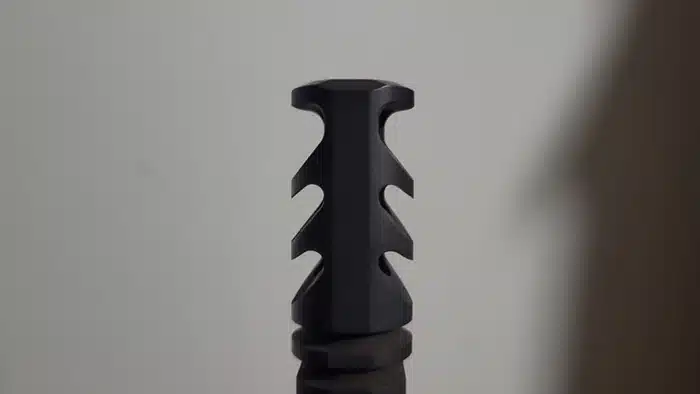
The Precision Armament M4-72 brake features six large cut ports angled back at about 45 degrees towards the shooter. This is a reverse venting design, which we’ll cover short. It comes in 5.56mm/223 and 7.62mm/.308 variants each weighing 2.6 and 3.1 ounces respectively at 2.250 and 2.275in long, made out of HTSR 416 Steel in black CrCn (Black) or Matte Stainless Steel finishes. I got the Black in 5.56. For proper timing, PA offers their proprietary AccuWashers, which I fully recommend with their system. They give you well more than enough to time this and several other platforms with one order.
Price directly from Precision Armament is $89.99 for the 5.56mm version, and $99.99 for the 7.62mm. Let’s talk about how the brake works.
How A Muzzle Brake Functions
As a physicist, my favorite part is the theory of operation: Reverse Venting. It’s a very simple concept. Contrary to popular belief, almost all of the recoil of a platform is a result of the gasses leaving the barrel after firing. This creates the basis for brake geometries that reduce felt recoil. A design such as this vents a considerable portion of the gas towards the sides of the shooter. Newton’s Third Law (for every action there is an equal and opposite reaction) tells us that this results in a considerable amount of force imparted forward on the rifle. Balancing this with the fraction of gas still going forward behind the round, results in significant recoil reduction.
The company boasts a 75% recoil reduction from this design. While I don’t at present have quantitative force measurements to back that up, I can certainly attest that it’s at least damn close, if not better.
Using Our Muzzle Brake
A muzzle brake, is straightforward. Time it. Lock it in. Run it. I run mine on a 14.5″ barrel, which I’ve pinned and welded to get me out of SBR land. Drilling through the brake to P&W it was trivial with the appropriate bits, which was appreciated. Mine has stayed stable for the entire time of use of about 7 months and around 1000 rounds.
Now for the good stuff: how it performs. This. Thing. F*cks. I’ve fired suppressed platforms that have more muzzle rise. I was able to take my comfortable controlled pairs from around .28s to 0.14s consistently: a factor of two just from the brake. The accuracy is there as well. I went from watching my reticle flick entirely off target with a linear compensator, bird cage, and other comps, to it essentially not moving at all aside from my own bodily impulses while firing. Additionally, I was thoroughly disgusted by the amount of confidence I was able to gain from my reticle essentially remaining stable. If the reticle doesn’t move, I simply pull again as fast as I can.
However, we get nothing for free. So what’s the downside? By design, a boatload of that gas is coming back at you. As a result, you get a good portion of the pressure & shock wave that comes out of the barrel. It’s gonna warm your face in the winter and feel like a strong cup of coffee. You definitely wanna keep your mouth closed while shooting it. My very first shot through it legitimately scared me it was so violent. On top of that, it’s disgustingly loud and unpleasant for anyone around: it’s the stark opposite of any concept of signal suppression. These are the downsides of these types of designs in general.
I run my grip as far forward as I can up my handguard to the point my knuckles are in range of the blast cone from this device. The first match I used it, I developed flash burns on my knuckles (mainly just darkening and callousing of the skin). Once that skin fell off and healed, it hasn’t happened since. This is all to say it creates a mean fireball in a two cones around it. The company (and myself) highly discourage using this on anything shorting than 14.5″ barrels for this exact reason. On shorter platforms, more gas is going to hit the design and come right back at you, and the results will most certainly not be very pleasant.
I will say, however, if you can get past the blast, this device is absolutely phenomenal! I can attest that when a buzzer goes off, the blast is the last thing on my mind.

Summary
Long story short, I think the pros heavily outweigh the cons on this device, especially if you’re in the market for significant recoil reduction and RO’s hating you for around 100 bucks. Enjoy some footage of this thing in action!
Pros:
- Disgusting Recoil Reduction (Literally flat on a 14.5″, the minimum recommended)
Cons:
- Super loud
- May burn you
- Massive pressure wave toward the shooter
Devil 6-1
AUTHOR'S NOTES | April 1st 2025
I think my other favorite part about this piece of gear are the responses from RO’s and fellow competitors. Either flinching or the group, “Damn!” on the first trigger pulls. Warming of the hand and face in the Winter from it is also definitely a plus for me, and in all honestly this thing makes me question suppressing this particular platform from the fun alone!
-Devil 6-1