
Introduction
Three major matches are officially on the books!
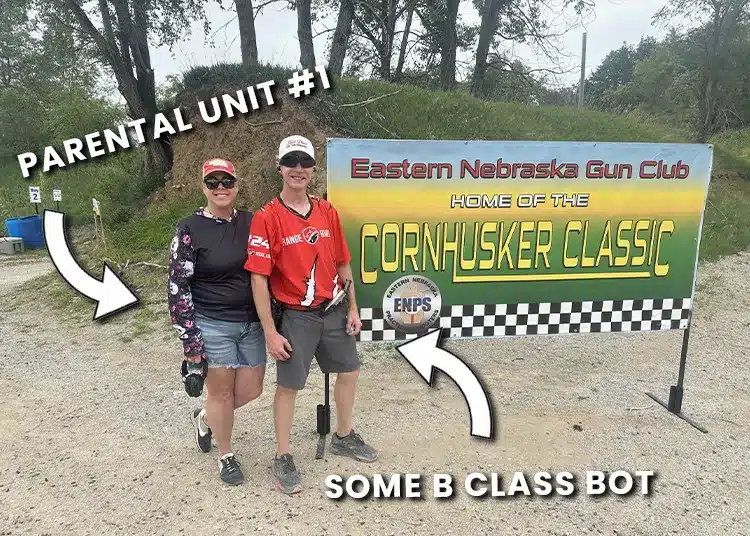
Some of you might be surprised to see me shooting any major match outside of Area 5, let alone in Nebraska of all places. Having both of my parents originally from Nebraska made this a no-brainer when one of them mentioned they would be coming out to see family at the same time anyway. Fortunately, I was offered one of the additional Saturday slots to shoot with staff before the actual match the next day.
I want to thank both Stephan and Thomas, the event’s respective Match Director and Range Master, for truly putting on an event I cannot wait to return to. A special shoutout also goes to Michelle, owner of MW Aktiv Wear, for helping me get a match jersey ordered after the fact, given that I did not have the opportunity while I was on the waitlist.
MATCH FOOTAGE
Many of you know I am in a difficult phase of growth within my own practical shooting skills. What previously felt like glass ceilings to break through has now become a difficult climb where the smallest mistakes can snowball into meaningful setbacks.
While I certainly did not shoot this match as well as I would have liked, I definitely found moments of success, even if only briefly, from more consistent training than what preceded Buckeye Blast.
I would also double down on my previous comments about consistency and the importance of not letting issues snowball into poor performance. If I can do anything between now and Area 5, it is ultimately to become more consistent at the basics.
Thank you to AimCam for the continued support in our process!
NEBRASKA STATE MATCH REVIEW
Match Format, Staff, & Operations
The Cornhusker Classic was hosted by the Eastern Nebraska Gun Club, as it has been since its inception in 2018. USPSA shooters from both South Dakota and Nebraska previously shared a “Great Plains Championship” sectional, which led to neither region having a reliable way to participate in a yearly Level 2 match. The Cornhusker Classic was Nebraska’s response to that need for a reliable Level 2 match in the region.
As mentioned, I got to shoot on staff day before the actual event, so I was able to see how some of the stages developed before being run the following day. Thomas, the previously mentioned Range Master, was fortunately also in our squad, which meant I got to see the work, leadership, and adjustments being made in real time. He shot his own match with a revolver while also bouncing between stages to help staff members as needed.
My only negative comment about the procedure of the match came from the first stage within the group I shot. Two staff members, who could not immediately locate a missing target, scored it as a double alpha and had the score approved before confirming that the target they missed was indeed behind a set of barrels. It was, in fact, two alpha. Later, when I saw the same scorekeeper having difficulty with their path, those waiting to paste were asked to call out hits rather than the scorekeeper verifying them directly as one of the two officials assigned between timer and tablet.
At a major match, this is generally not consistent with Rules 9.1.1 and the Match Staffing Authority section of the handbook. I pointed it out as such and was corrected by the previous Area 3 Director, who told me I was wrong without further explanation. Later in the day, when I made a mistake and pasted a target for the same person who had told me it was not an issue, it suddenly became an issue, despite me being able to verify the hits. Thomas explained that because I was not official staff, the run had to be reshot.
In reality, no one but that stage’s staff should be scoring the stage. A delegate may be assigned directly for understaffed stages, but ultimately, when a staff member is off their stage and not actively running the timer or tablet, they are simply a competitor. For competitive integrity, this should be enforced consistently in the future, especially when friendships and rankings are both involved.
Stage Design
The stage designs were different from what I had previously experienced at my two prior majors. This might simply be a perception issue, given that Indiana was my first major and Buckeye Blast felt like a genuine love letter to Level 3 preparation. At face value, however, the Cornhusker Classic stages felt easier on an individual level.
That did not mean the match as a whole was any easier. On the contrary, if something seemed easy, there was likely a trick spot designed into the stage that could ultimately be run several different ways.
I got caught disrespecting the risk of a running popper shot on more than one occasion due to the confidence I had in the size of the steel. While I had not yet experienced short courses in a major match, I felt the staff addressed their available space and difficulty requirements appropriately through challenge items, dynamic targets, and timing-based target presentations.
All in all, Cornhusker Classic put on a good show for its participants.
Competitor Highlights
I wanted to include another competitor highlights section, as we did in the first Buckeye Blast article. I think it is safe to say we often take for granted the quality of opportunity we have in Fort Wayne, Indiana. This is largely due to how many amazing competitors we get to cross paths with between Michigan, Indiana, and Ohio.
USPSA being a mostly volunteer sport means our environments are only as strong as the competitors themselves. I was very fortunate to meet a few of the locals at ENGC who are doing the same for their club.
Thomas Howard – As mentioned above, Tom was the Range Master for the match. He was also the coolest lefty to show up that weekend, as he participated with his revolver. As far as professionalism and sportsmanship go, Tom was an excellent representative of his club. I very much enjoyed seeing him clear stages just as fast as many of the striker-fired counterparts.
Heidi Wullschleger – Heidi was clearly a one-of-a-kind local within her group. It was insanely impressive to see how aggressive she was on every target while constantly moving to her next position. I have yet to see a competitor who was not already in the top 5 to 10 percent move with the confidence she did and still get their hits.
The biggest tragedy of watching Heidi’s performance was the fact that nearly half of her Charlies were so close to the perf that you almost cried on her behalf. I cannot wait to see that letter G next to her name down the road.
Andy Erickson – The previous Match Director of Area 3, Andy came with experience. It was not much later than our second stage of the day when I found myself adopting parts of his stage plan that I had either missed or had not considered. I really appreciated his willingness to explain why he made certain choices, especially when it came down to making the best plan the easiest one.
Unfortunately, I pasted an Alpha on a target I thought had already been scored due to the tablet jumping in and out of our area. This felt twice as bad in my head given our previous Buckeye Blast experience. I am not going to lie when I say that after seeing Andy’s reaction, I had no desire to finish the match until he thankfully shot a better run on his reshoot 15 minutes later.
Austin Adams – Austin was an incredibly humble and great individual to talk to throughout the match. It took me a few stages to catch on that he was even shooting Production until I noticed how often he had to reload. I would be entirely interested in shooting in Austin’s squad again the next time I come back.
Would I Go Again?
Absolutely.
Between the staff, the location, and the excuse to see my family, I do not see why I would not want to. When I first looked up the Cornhusker Classic, it was clear that it was a newer major match location if you looked back just a few years. That made me extremely excited to see how far they had come. Even in videos posted by past competitors, it was obvious that the match only continued to get better every year.
I look forward to seeing where they take things in the future.